Your Dog Gets Plenty of Exercise. So Why Are They Still Restless?
Sometimes another walk isn’t the only thing your dog needs. Giving them more opportunities to sniff, think, learn and solve little problems can add a completely different kind of activity to their day.
Disclosure: This article contains affiliate links. If you make a purchase through one of these links, we may earn a commission at no additional cost to you.
You took your dog for a walk.
You played fetch.
They had dinner.
And somehow, at 8:30 p.m., they’re pacing around the house, staring out the window, stealing something they know they’re not supposed to have or suddenly deciding that every tiny noise outside requires an announcement.
It’s easy to assume the answer is more exercise.
And sometimes it is.
But physical exercise and mental activity aren’t exactly the same thing.
A dog can spend plenty of time moving their body and still have very few opportunities during the day to really use their brain—to search for something, figure something out, practice self-control or learn what you’re asking them to do.
That’s where mental enrichment can be useful.
And no, this doesn’t mean turning your living room into an elaborate dog obstacle course or spending an hour every night teaching complicated tricks.
Some of the best ways to get a dog thinking are surprisingly simple.
What Does “Mental Exercise” for a Dog Actually Mean?
Think about what happens during a normal walk.
If your goal is simply to cover a mile as quickly as possible, your dog gets physical activity.
But give that same dog time to sniff a patch of grass, investigate where another animal has been, check in with you, practice waiting at a curb and find a few treats scattered in the grass?
Now there’s a lot more going on.
They’re processing information.
They’re making choices.
They’re using their nose.
They’re paying attention.
They’re learning.
Mental enrichment can include things like:
- sniffing and searching games
- food puzzles
- learning new cues
- practicing impulse control
- finding hidden toys or treats
- learning the names of objects
- interactive training games
- practicing calm behavior around distractions
You don’t need to do all of these.
The bigger idea is simply to give your dog opportunities to do more than eat, sleep and burn off physical energy.
Signs Your Dog Might Enjoy More Mental Stimulation
There’s no checklist that can tell you with certainty that a dog is “bored.”
Dogs bark, chew, jump, whine and become restless for all kinds of reasons. Fear, anxiety, excitement, learned habits, lack of exercise and even medical issues can play a role.
So I’d be skeptical of anyone who tells you every unwanted behavior has one simple cause.
That said, it may be worth experimenting with more mental activity if your dog:
- seems ready for another activity five minutes after you get home from a walk
- constantly looks for something to investigate
- loves sniffing, searching or puzzle toys
- gets distracted very easily during training
- struggles to settle when exciting things are happening
- seems to enjoy learning tricks and figuring things out
- needs more constructive things to do while you’re busy at home
The nice thing about trying more brain games is that you don’t have to overhaul your routine.
Start with a few minutes.
See what your dog enjoys.
Start With Attention
One of the most useful things a dog can learn isn’t a flashy trick.
It’s simply:
Pay attention to me.
Think about how many other skills depend on that.
It’s hard to ask a dog to sit, stay, leave something alone or walk nicely with you if they’re completely focused on the squirrel, visitor, dog across the street or mysterious smell coming from the kitchen.
That’s why attention games can make a good starting point.
Dog trainer Adrienne Farricelli demonstrates one example called The Airplane Game:
What I like about this type of exercise is that the dog isn’t just being corrected every time they do something we don’t want.
Instead, we’re showing them what does earn the reward.
That small shift makes training feel a lot more like communication and a lot less like spending your entire day saying:
“No.”
“Leave it.”
“Stop.”
“Hey.”
“NO.”
If you have a dog, you probably know that sequence well.
Turn Things You Already Do Into Tiny Training Sessions
One of the reasons people give up on dog training is that it starts to feel like another item on the to-do list.
Walk dog.
Feed dog.
Answer emails.
Do laundry.
Train dog for 45 minutes.
Except training doesn’t have to happen in one big formal session.
You can build little bits of it into the day you already have.
Before you open the back door, ask for a moment of calm.
Before putting down dinner, practice waiting.
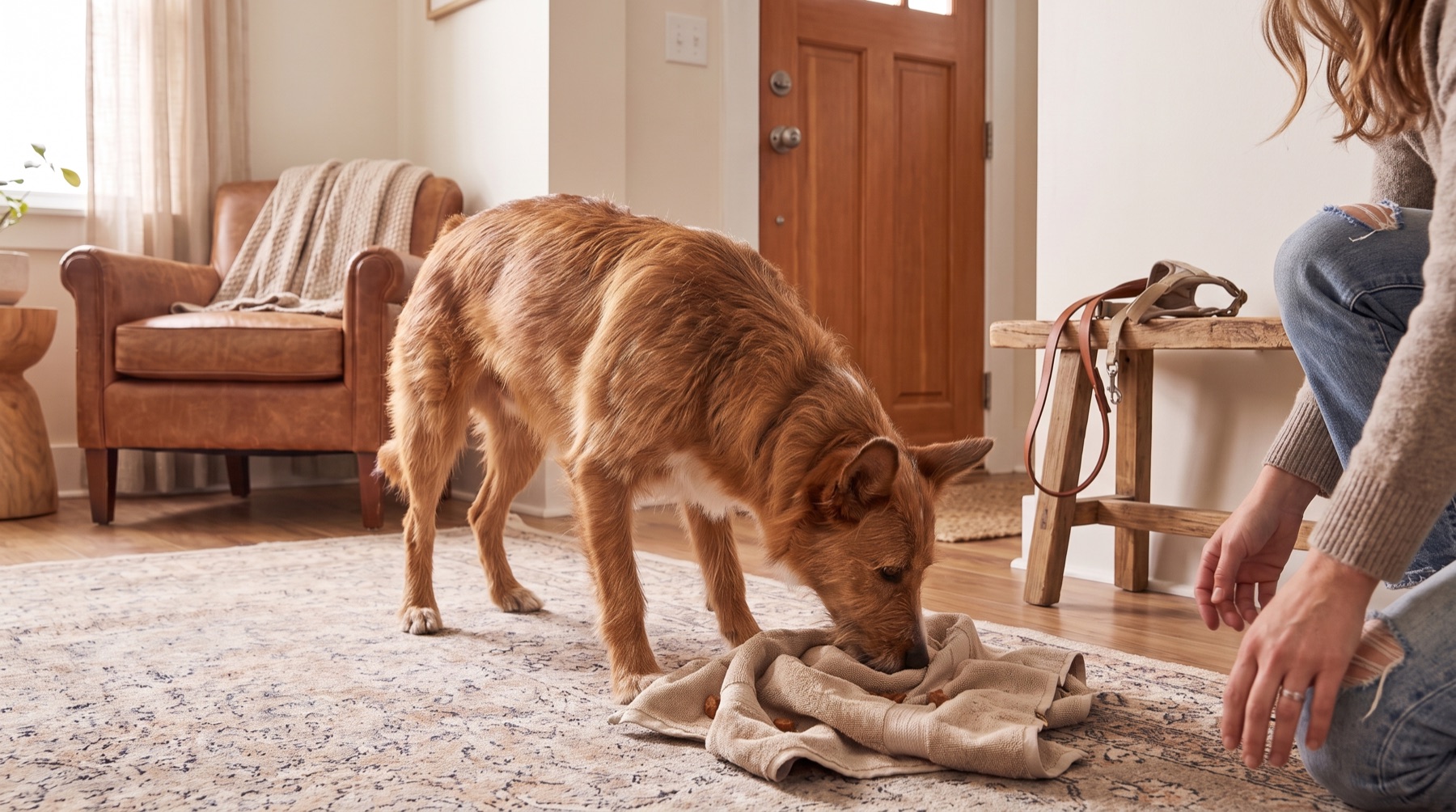
Hide a few pieces of kibble around a room and let your dog search for them.
Practice “leave it” while you’re already in the kitchen.
Ask for eye contact before tossing a favorite toy.
Teach them to touch your hand with their nose.
Put treats under a couple of cups and let them figure out where the food is.
You might only spend two or three minutes at a time doing any of these.
The point isn’t to create the world’s smartest dog.
It’s to make ordinary parts of their day a little more interesting.
Instead of Only Asking “How Do I Stop This?” Try Asking “What Should My Dog Do Instead?”
This was one of the ideas that made reward-based training click for me conceptually.
We tend to notice the behaviors we don’t want.
Don’t jump on guests.
Don’t bark.
Don’t pull.
Don’t grab that.
Don’t launch yourself through the door.
But stopping a behavior is only half the question.
The other half is:
What would you like your dog to do instead?
Jumping is a good example.
When someone comes through the door, the dog is excited and wants interaction. Simply repeating “off” tells them what not to do—but they still need another way to behave in that situation.
Farricelli demonstrates part of her approach to jumping in this video with Maggie:
Again, I wouldn’t take this to mean one technique will solve jumping for every dog.
Dogs are individuals.
But I like the underlying idea: give the dog a behavior they can succeed at, then reinforce it.
This Is Where Brain Games and Training Start to Overlap
Once you start looking at training this way, “mental stimulation” stops sounding like something separate you have to squeeze into the day.
Training itself can become mental enrichment.
A dog figuring out: What gets me the reward? is thinking.
A dog waiting for permission instead of immediately charging toward something they want is practicing impulse control.
A dog searching for a hidden object is solving a problem.
A dog learning to distinguish one toy from another is using memory and discrimination.
And that’s essentially the philosophy behind a dog-training program I came across called Brain Training for Dogs.
What Is Brain Training for Dogs?
Brain Training for Dogs is an online program created by professional dog trainer Adrienne Farricelli.
Rather than organizing everything around obedience commands alone, the program uses a progression of games designed to work on skills such as attention, patience, impulse control and problem-solving.
The current program contains more than 21 games arranged in increasingly advanced modules, beginning with foundational attention work and progressing to things like scent games, patience exercises and advanced tricks. It also includes obedience material, video demonstrations and a library covering common dog-training and behavior topics.
Some of the exercises have very un-serious names—which I actually appreciate.
There’s a Treasure Hunt Game.
A Muffin Game.
A Shell Game.
Hide and Seek.
And yes, eventually there are things like teaching a dog to tidy up toys and even play a little piano.
I wouldn’t buy a training program because I desperately need my dog to become a pianist.
But I do like the broader idea behind it:
Give the dog something to figure out.
If the training feels like a game, you’re probably more likely to keep doing it—and your dog may be more interested in participating too.
Who Might Like This Approach?
I think the program makes the most sense for someone who:
- prefers reward-based training over harsh corrections
- wants more ideas for mentally engaging their dog
- likes short activities they can practice at home
- wants training exercises arranged in a logical progression
- learns better from demonstrations and step-by-step instructions
- has found themselves bouncing between random YouTube videos trying to figure out what to teach next
That last one matters more than it sounds.
There is an enormous amount of free dog-training information online.
The problem usually isn’t finding an exercise.
It’s figuring out what to work on first, what to do next and how all those disconnected tips fit together.
A structured program can be useful simply because someone else has already organized that process for you.
What This Program Isn’t
I also wouldn’t look at Brain Training for Dogs—or any online dog-training course—as a substitute for professional help in every situation.
Some behavior problems are more complicated than boredom or a lack of training.
If your dog has bitten someone, is showing serious aggression, has severe fear or anxiety, or suddenly develops a significant change in behavior, your veterinarian should be part of the conversation. Depending on the situation, an appropriately qualified trainer or veterinary behavior professional may also be the better route.
And if a behavior suddenly appears out of nowhere, don’t automatically assume it’s a training problem. Pain and other medical issues can affect behavior too.
Online training is best viewed as another tool.
Not magic.
You Don’t Need a “Genius” Dog
The name Brain Training for Dogs is obviously playful.
Your dog does not need to graduate from canine university.
They don’t need a diploma.
They definitely don’t need to learn calculus.
But giving them more opportunities to pay attention, make choices, solve little problems and work with you can make everyday training much more interesting.
And sometimes it’s a useful reminder for us, too.
We can get so focused on stopping the annoying thing our dog is doing that we forget to give them something better to do.
So before automatically adding another long walk to the schedule, try something different.
Hide a treat.
Teach a new cue.
Practice waiting at the door.
Play a scent game.
Work on eye contact.
Give your dog a tiny problem to solve.
Then see what happens.